A Strategic Guide for Enterprises, GCCs, and International Companies Entering India
When a foreign company or a domestic enterprise decides to establish operations in a new city Bangalore, Hyderabad, Mumbai, or beyond one of the first and most consequential decisions they face is deceptively simple: Do we set up a virtual office or a coworking space?
Get it right, and you accelerate market entry while controlling costs. Get it wrong, and you either burn capital on space you don’t need or lose credibility, talent, and operational momentum because your setup doesn’t match your actual ambitions.
This guide cuts through the confusion. Drawing on real market data, compliance realities, and the practical experience of setting up hundreds of enterprise offices across India, we break down exactly when each option wins and what the true cost of choosing the wrong one looks like.
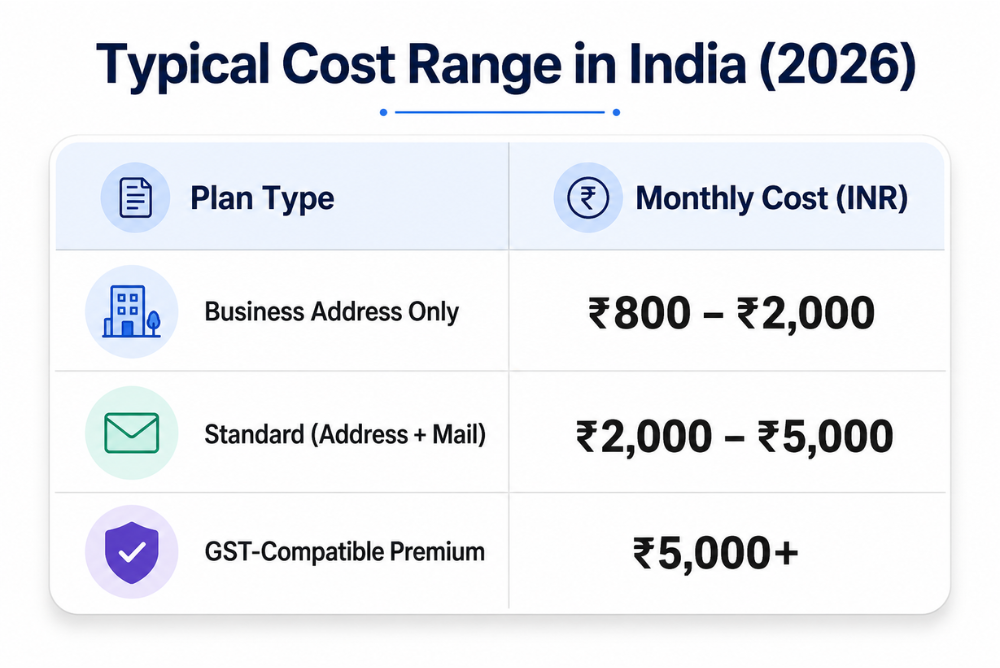
A virtual office provides a registered business address, mail handling, GST documentation, and sometimes access to meeting rooms without any physical dedicated workspace. You get the postal address and compliance credentials of being “in” Bangalore’s EPIP Zone or Mumbai’s BKC, but your team works from home, from client sites, or from another location entirely.
What a virtual office typically includes:
A coworking space is a physical, professionally managed shared workspace where your team works daily with access to desks, private offices, conference rooms, high-speed internet, cafeteria, and a professional business environment. It functions as a fully operational office without the burdens of a traditional lease.
What a coworking space typically includes:
At GoodWorks Workspace Top ranked Coworking Space in Bangalore by Coworker.com our managed coworking centers across Whitefield (EPIP Zone, Prestige Shantiniketan, SJR iPark, Marathahalli Road), Electronic City, ORR Bellandur, MG Road, Manyata Tech Park, Indiranagar, and Koramangala serve teams from 1 seat to 1,000+ seats.
India’s workspace market is experiencing structural, not cyclical, growth. Understanding the scale makes the stakes of this decision clear.
India’s coworking market is projected to reach USD 3.98 billion in 2025 and grow to USD 7.71 billion by 2030 at a 14.14% CAGR, driven by hybrid work adoption cited by 73% of occupiers and rapid enterprise expansion. Large enterprise facilities accounted for 53.2% of 2024 revenue, reflecting that scale-seeking corporates not just freelancers are now the dominant coworking users.
On the GCC front, the numbers are even more compelling. India now hosts over 1,800 GCCs employing 1.9 million professionals, generating approximately USD 64.6 billion in revenue in FY24. The GCC ecosystem is projected to grow to a $110 billion market by 2030. In Q1 and Q2 of 2025 alone, 16+ new GCCs were established each quarter predominantly from North America and Europe, choosing Bengaluru, Hyderabad, and Pune as their landing cities.
GCCs now account for nearly 40% of total office space absorption in India as of late 2025. These are not companies setting up postal addresses. They are setting up physical operations and they need workspaces that can support that.
Virtual Office wins for:
Foreign companies entering India often cannot complete GST filings or legally conduct many forms of business without a registered address. A virtual office provides an address accepted by tax authorities enabling smooth GST registration and invoicing to Indian clients while eliminating the cost of maintaining physical space.
Important: A virtual office address alone does not constitute a fully functional operational base. It is a compliance tool, not a business-building tool.
Coworking Space wins for:
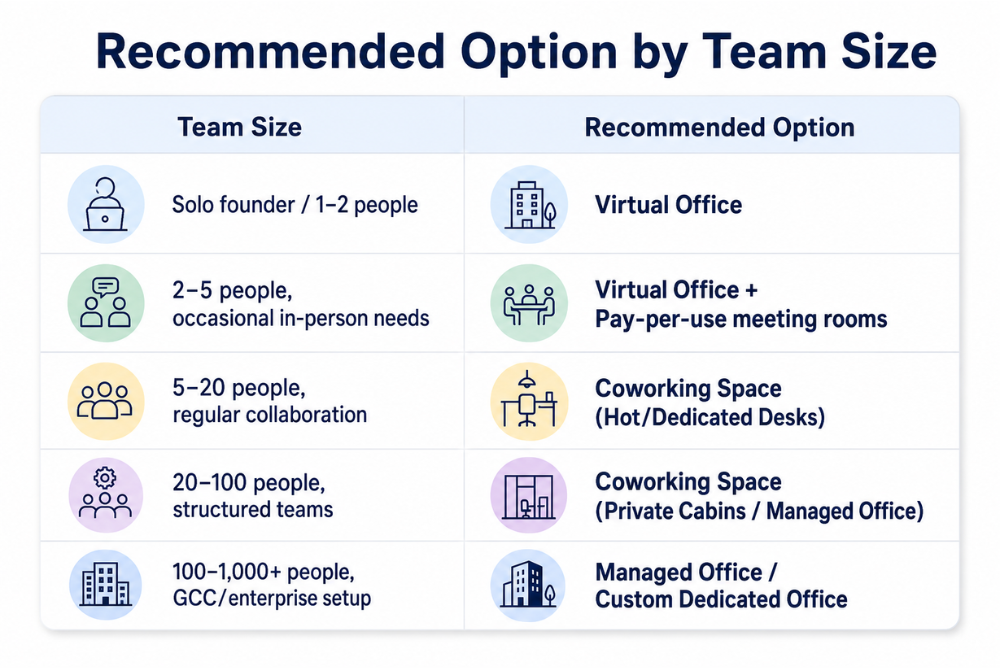
The inflection point is clear: once your team needs to show up consistently and collaborate, a virtual office becomes a liability, not an asset.
One of the most persistent misconceptions is that a virtual office is always cheaper. That depends entirely on what you’re comparing it to.
Scenario: 20-person tech team, Bangalore, 12-month horizon
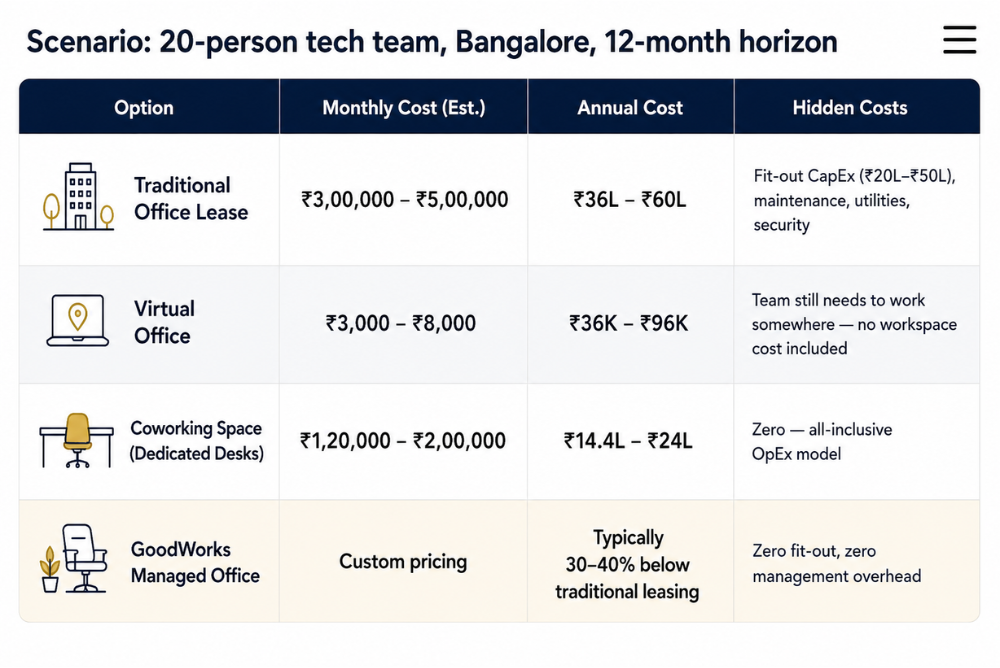
The virtual office wins on raw address costs. But when you factor in that your 20-person team still needs to work somewhere coffee shops, employee homes, rented meeting rooms the total cost of operations climbs significantly and the productivity cost is unmeasurable.
This factor is underweighted in most comparisons.
When a potential enterprise client, a senior hire, or a government representative visits your office or even looks it up what they find matters. A premium address in Whitefield’s SJR iPark or Prestige Shantiniketan communicates scale, stability, and seriousness. A virtual office with the same address communicates a postbox.
For companies pursuing:
…a physical, operational coworking or managed office is a competitive asset. The workspace becomes part of your employer brand and sales credibility.
Virtual Office: Fastest possible entry
Coworking Space: Rapid but structured
Both options dramatically outperform traditional leasing, which can take 3–6 months from search to occupation once fit-out is included.
A virtual office has a hard ceiling. It scales in paper, not in people. The moment your headcount grows, you outgrow it but you’ve already invested time in the compliance setup, and switching adds friction.
Coworking spaces like GoodWorks are built for elastic growth. You can start with 5 dedicated desks in Whitefield EPIP Zone and expand to a 200-seat custom managed office in the same ecosystem — no relocation, no disruption, no capital expenditure reset.
GoodWorks’ model specifically accommodates teams from 1 seater to 1,000+ seaters within the same operational platform across 7 centers in Whitefield alone.
Be strategic about this. A virtual office genuinely wins in the following scenarios:
1. Market sensing before market entry You want to test demand, register for GST, and receive mail while your India strategy is still being validated. Spending ₹5,000/month to maintain a legitimate address while your business development team visits quarterly is rational.
2. Multi-city regulatory footprint You operate from Bangalore but need GST registration in Mumbai and Chennai for billing purposes. Virtual offices in each city cost a fraction of physical space and fulfill the compliance requirement cleanly.
3. Remote-first companies with no local team If your India operation is 2 remote engineers who are productive from home and you have no immediate plans to hire locally, a virtual office plus occasional meeting room bookings may be adequate for 12–18 months.
4. Cost-conscious early-stage startups Pre-revenue or seed-stage companies where every rupee is accounted for, with founding teams comfortable working from personal setups or shared spaces on an ad-hoc basis.
1. You’re hiring and need a workspace to attract talent The single most underappreciated factor in India’s talent market. Top engineers in Bangalore evaluate their offer based on office quality, commute, and workspace culture. A beautiful coworking space in Whitefield or Manyata Tech Park is a recruiting asset.
2. GCC or captive center setup If you’re a global company establishing a Global Capability Center in India, a managed coworking or dedicated managed office is the baseline. India’s GCC ecosystem has grown to over 1,800 centers precisely because global enterprises need physical infrastructure to build teams, culture, and capability not just a registered address.
The data here is unambiguous.
India welcomed 16+ new GCCs per quarter in both Q1 and Q2 of 2025. These were companies from North America, Europe, and APAC primarily in software, BFSI, healthcare, and professional services choosing cities like Bengaluru, Hyderabad, and Pune.
Not one of them set up a virtual office as their primary India entry vehicle.
They chose managed offices and dedicated coworking facilities because:
The GoodWorks Sansovi GCC offering exists specifically to bridge this gap providing global companies with the full-stack infrastructure needed to establish a functioning GCC in India: workspace, compliance, talent access, and operational management, all within a single platform.
3. Client-facing operations Consulting firms, financial services companies, technology vendors meeting Indian enterprise clients need a professional physical location. The meeting room in your virtual office plan is a pay-per-use afterthought. The conference suite in your coworking center is always available.
4. Teams of 10 or more Coordination costs, culture dilution, and productivity loss from distributed home working typically outweigh coworking costs for teams of this size — especially in the first 12–24 months of India operations.
5. You want operational leverage, not just compliance A managed coworking space provides IT support, facility management, food and beverage, security, community, and business services under one roof. Your leadership team focuses on the business, not on running an office.
GoodWorks Workspace offers both virtual office and coworking/managed office solutions across Bangalore, Hyderabad, Mumbai, and Kolkata designed specifically for the enterprise and GCC market entry journey.
Virtual Offices available in: Bangalore (Whitefield EPIP Zone, Electronic City, ORR Bellandur, MG Road, Manyata Tech Park, Indiranagar, Koramangala, Marathahalli Road) | Hyderabad | Mumbai | Kolkata | Chennai | Noida | Pune | Dubai | Abu Dhabi
Coworking & Managed Office spaces in Bangalore’s Whitefield:
All centers include: Business lounge, GoodWorks HQ App, gourmet coffee, cafeteria, car parking, enterprise-grade internet, meeting rooms, and the GoodWorks Advantage partner benefits program.
Explore Coworking Spaces in Whitefield →