For most mature Global Capability Centres, Outer Ring Road remains Bengaluru’s strongest location for immediate access to experienced technology and corporate talent. It also carries the highest occupancy cost and the greatest exposure to road congestion.
Whitefield offers a better balance between talent, office cost, residential depth and operational readiness. The Purple Line has improved its public transport position, while its large technology parks and established residential catchment make it suitable for GCCs that expect sustained hiring.
North Bangalore offers the strongest long term expansion case. It provides airport access, newer commercial campuses and more headroom for growth. However, companies must evaluate the exact office address carefully because talent access, public transport and social infrastructure vary significantly across Hebbal, Nagavara, Thanisandra, Yelahanka and Devanahalli.
The right choice depends on the GCC mandate:
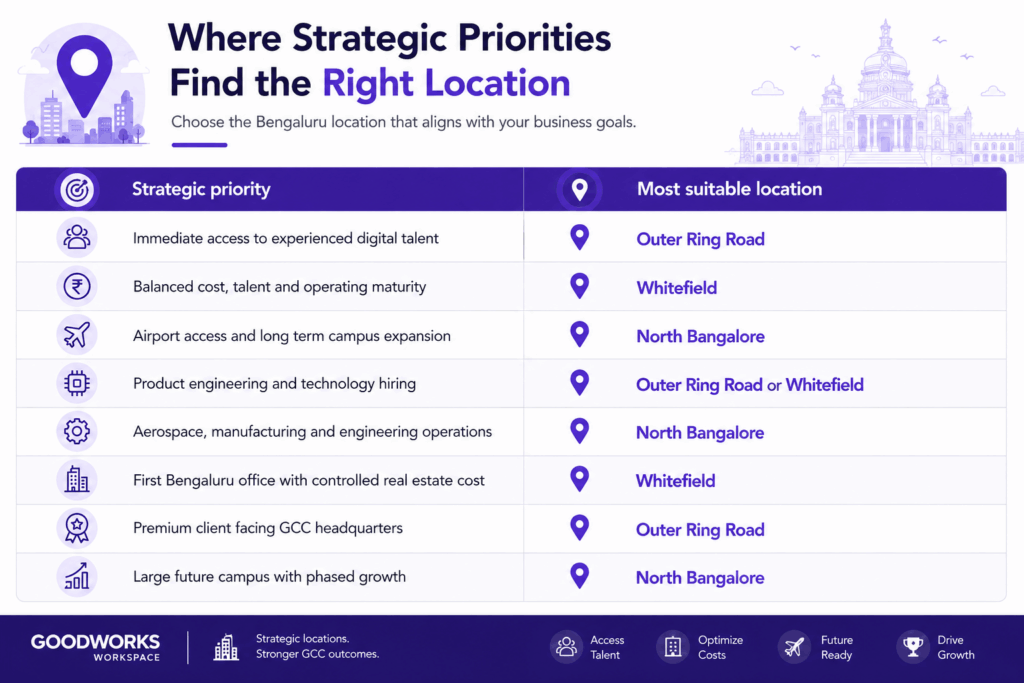
This is not simply a rent comparison. A GCC location decision affects hiring velocity, employee retention, transport expenditure, leadership access, business continuity and the ability to expand without relocating.
Bengaluru continues to offer the country’s deepest concentration of GCCs, experienced technology professionals, engineering talent and enterprise service providers.
The Government of Karnataka reported that Bengaluru had more than 875 GCC units when it published the Karnataka GCC policy material in 2024. The same report identified Outer Ring Road as one of the city’s leading GCC leasing markets. It also noted that Bengaluru’s office stock had grown from about 100 million square feet in 2013 to more than 223 million square feet by the second quarter of 2024.
The city’s position is not limited to software services. Bengaluru hosts significant GCC activity across banking, financial services, retail, healthcare, engineering, manufacturing, data, cybersecurity and research.
Office leasing data confirms that GCC demand remains strong. Cushman and Wakefield reported that GCCs accounted for 45 percent of Bengaluru’s gross office leasing during the third quarter of 2025. Outer Ring Road alone contributed 40 percent of leasing during that quarter.
More recent market data shows the same pattern. In the second quarter of 2026, GCCs accounted for 52 percent of Bengaluru office leasing, while Outer Ring Road and Peripheral East remained among the most active office markets.
For a foreign enterprise, the question is therefore not whether Bengaluru has the ecosystem to support a GCC. The more difficult question is where within Bengaluru the GCC should operate.
Property consultants do not always use Bengaluru location names in the same way that occupiers and employees use them.
In local business usage, Outer Ring Road usually refers to the technology corridor from Mahadevapura and Marathahalli through Bellandur to Sarjapur Road and Central Silk Board.
In Cushman and Wakefield’s reporting, the Outer Ring Road category also includes KR Puram and Hebbal. Whitefield appears under Peripheral East. North Bangalore locations such as Bellary Road, Thanisandra Road and Tumkur Road appear under Peripheral North.
This article uses the following practical definitions:
Whitefield: EPIP Zone, ITPL, Brookefield, Hoodi, Kadugodi, Hope Farm and nearby eastern technology clusters.
Outer Ring Road: Mahadevapura, Doddanekundi, Marathahalli, Kadubeesanahalli, Bellandur and the Sarjapur Road junction corridor.
North Bangalore: Hebbal, Nagavara, Thanisandra, Jakkur, Yelahanka, Bellary Road and the wider airport corridor towards Devanahalli.
Senior decision makers should ask consultants to provide building level data rather than relying only on broad market labels.
Whitefield is one of Bengaluru’s most established technology districts. It combines large technology parks, Grade A office buildings, residential communities, international schools, hospitals, hotels, shopping centres and a wide range of employee services.
Its main advantage is balance. It does not always lead on a single parameter, but it performs well across most factors that matter to a GCC.
Whitefield can support technology, finance, shared services, customer operations, analytics, healthcare, retail and engineering teams. It also provides a large base of employees who already live in Whitefield, Brookefield, Hoodi, KR Puram, Varthur and nearby neighbourhoods.
Cushman and Wakefield classified Whitefield under Peripheral East in its third quarter 2025 Bengaluru report. The market contained approximately 44 million square feet of Grade A office stock. It had a reported vacancy rate of 13.5 percent and a stock weighted average asking rent of about ₹72 per square foot per month. The consultant also tracked approximately 6.34 million square feet of planned and under construction space in the market.
These figures suggest three practical advantages for occupiers:
The ₹72 figure is not a final occupancy cost. It represents a stock weighted asking rent for Grade A space with specified building services. A GCC must add maintenance, parking, power, fit out, transport, taxes and workplace operations to determine the true annual cost.
Whitefield provides strong access to employees who live in East Bengaluru. This includes experienced staff working in technology, cloud engineering, enterprise software, analytics, support services, finance operations and product development.
The challenge appears when the hiring catchment extends heavily into South Bengaluru or central neighbourhoods. Employees travelling from HSR Layout, Koramangala, BTM Layout, Bannerghatta Road or JP Nagar may face long and variable journeys.
The Purple Line has improved Whitefield’s accessibility from central, eastern and western Bengaluru. It gives employers a transport option that does not depend entirely on road traffic. However, the benefit depends on the office’s distance from a station and the quality of last mile transport.
A building near Pattandur Agrahara, Kadugodi, Hope Farm, ITPL or another accessible metro station may produce a different employee experience from a property several kilometres away on a congested internal road.
Whitefield can work well for CFOs seeking a disciplined occupancy strategy without moving the GCC to an immature business district.
Compared with Outer Ring Road, the lower quoted market rent can create room in the budget for:
For a GCC, cost per square foot is less useful than cost per productive employee.
A dense office with poor access may show a lower property cost but create higher transport expenditure, employee fatigue and attrition. A well planned managed office with more space per employee can support collaboration, acoustic privacy and long working sessions more effectively.
Whitefield is not a uniform market. Internal roads, junction capacity, drainage, water arrangements and last mile access vary by property.
The key risks are:
Whitefield is a strong fit for:
Why Outer Ring Road remains the benchmark?
Outer Ring Road has the most concentrated enterprise technology ecosystem among the three locations.
The corridor contains major business parks, multinational occupiers, technology service providers, enterprise vendors and a large pool of experienced professionals. It has developed a strong labour market because employees can move between companies without leaving the same broad corridor.
For CEOs and CTOs, this creates a clear strategic advantage. A new GCC can recruit leaders and specialist teams from an existing enterprise ecosystem.
For CFOs, the same concentration creates a cost challenge. Strong demand, lower vacancy and premium buildings tend to support higher occupancy costs.
Cushman and Wakefield reported approximately 93.27 million square feet of Grade A office stock in its Outer Ring Road category during the third quarter of 2025. The category recorded a 6.6 percent vacancy rate and a stock weighted average asking rent of approximately ₹104.50 per square foot per month. It also had about 16.66 million square feet of planned and under construction supply.
The corridor accounted for 40 percent of Bengaluru’s gross leasing volume in the third quarter of 2025. It also represented nearly 88 percent of the city’s office completions during that quarter, based on Cushman and Wakefield’s market classification.
ICRA separately identified Outer Ring Road, Whitefield and Nagavara as Bengaluru’s three largest office micro markets, collectively accounting for about 36 percent of the city’s office supply as of December 2024. ICRA expected vacancy to remain low on Outer Ring Road because of healthy absorption.
These figures confirm that Outer Ring Road combines scale with strong demand. They also show why companies should not assume that a large market automatically provides abundant ready space.
Outer Ring Road offers direct access to experienced professionals in:
Many technology professionals live in Bellandur, HSR Layout, Sarjapur Road, Marathahalli, Mahadevapura, Brookefield, Kadubeesanahalli and nearby areas.
This helps employers recruit lateral talent. It can also reduce relocation resistance among candidates already working on the corridor.
The limitation is congestion. A short distance on a map does not guarantee a predictable commute. Office entry points, service roads, junctions and employee shift timings can materially affect travel time.
The planned Blue Line is expected to improve access along the corridor and connect it with the airport. However, companies making a current lease decision should not treat future metro service as an existing benefit. Public statements in 2026 placed operational readiness for the airport connection towards the end of 2027.
A lease decision should therefore use two transport scenarios:
Current scenario: Road based employee movement with available bus and shuttle networks.
Future scenario: Metro supported access after the relevant line and stations become operational.
Outer Ring Road can justify its premium when talent access directly influences revenue, product delivery or intellectual property creation.
A product engineering GCC may accept higher rent if the location reduces the time required to hire senior architects, platform engineers, cybersecurity leaders and data specialists.
The financial analysis should include:
A lower rent in another district may not compensate for slower hiring in scarce skill categories. Conversely, a back office or transaction processing operation may not gain enough from the talent premium to justify Outer Ring Road’s occupancy cost.
The corridor’s main risks are well known but should not be treated casually.
They include:
Building level due diligence must cover backup power, water sources, internet diversity, emergency access, flood history, parking ratios and transport staging capacity.
A premium address does not remove operational risk. The technical condition of the building and the access route matter as much as the brand of the business park.
Outer Ring Road is a strong fit for:
Why North Bangalore is attracting GCC interest?
North Bangalore has developed around three major drivers:
North Bangalore should not be treated as one homogeneous office market.
Hebbal and Nagavara have a mature corporate environment and relatively strong access to established residential areas. Thanisandra and Jakkur offer growing residential and commercial ecosystems. Yelahanka provides established social infrastructure. Devanahalli offers airport proximity and future development capacity but remains farther from much of Bengaluru’s existing technology workforce.
Cushman and Wakefield’s Peripheral North category, which includes Bellary Road, Thanisandra Road and Tumkur Road, had approximately 14.7 million square feet of Grade A stock in the third quarter of 2025. It recorded a vacancy rate of 15 percent and a stock weighted average asking rent of approximately ₹74.60 per square foot per month. The consultant tracked just over 7 million square feet of planned and under construction stock in the category.
This indicates a smaller existing office market than Whitefield or Outer Ring Road, but one with meaningful future supply.
North Bangalore also accounted for 28 percent of Bengaluru’s residential launches in the second quarter of 2026, according to Cushman and Wakefield. This matters because office growth becomes more sustainable when housing, schools, healthcare and retail develop alongside employment.
Airport access is North Bangalore’s clearest advantage.
This matters most for GCCs where global executives, customers, engineering leaders or regional teams travel frequently. A location near Hebbal or along Bellary Road can reduce the unpredictability of repeated airport journeys.
However, companies should not overstate this benefit. Most employees do not travel to the airport every day. The office must still work for the daily workforce.
An address that saves visiting executives 30 minutes but adds 45 minutes to thousands of employee journeys may not produce a positive business outcome.
The appropriate balance depends on the operating model:
North Bangalore draws employees from Hebbal, Nagavara, Hennur, Thanisandra, Jakkur, Yelahanka, Sahakar Nagar, Kalyan Nagar, HRBR Layout and parts of central Bengaluru.
It can also attract professionals who prefer newer residential communities and easier airport access.
Its challenge is access to the established workforce living in Whitefield, Sarjapur Road, Electronic City and South Bengaluru. Cross city travel can reduce candidate interest unless the company offers a strong role, flexible attendance policy or reliable transport.
The talent assessment should distinguish between:
North Bangalore may perform well for a new operation building its workforce over several years. It may be less suitable for a rapid consolidation of existing employees who currently live in East or South Bengaluru.
North Bangalore offers a compelling option for GCCs planning large and phased growth.
Compared with Outer Ring Road, occupiers may find:
The financial risk lies in committing too early to an office that employees find difficult to reach.
A lower lease rate may be offset by:
North Bangalore works best when real estate, talent and transport planning happen together.
The level of risk depends heavily on the exact submarket.
Key issues include:
As with Outer Ring Road, the Blue Line is expected to improve future connectivity. Current decisions should still be justified using today’s access conditions rather than the proposed network alone.
North Bangalore is a strong fit for:
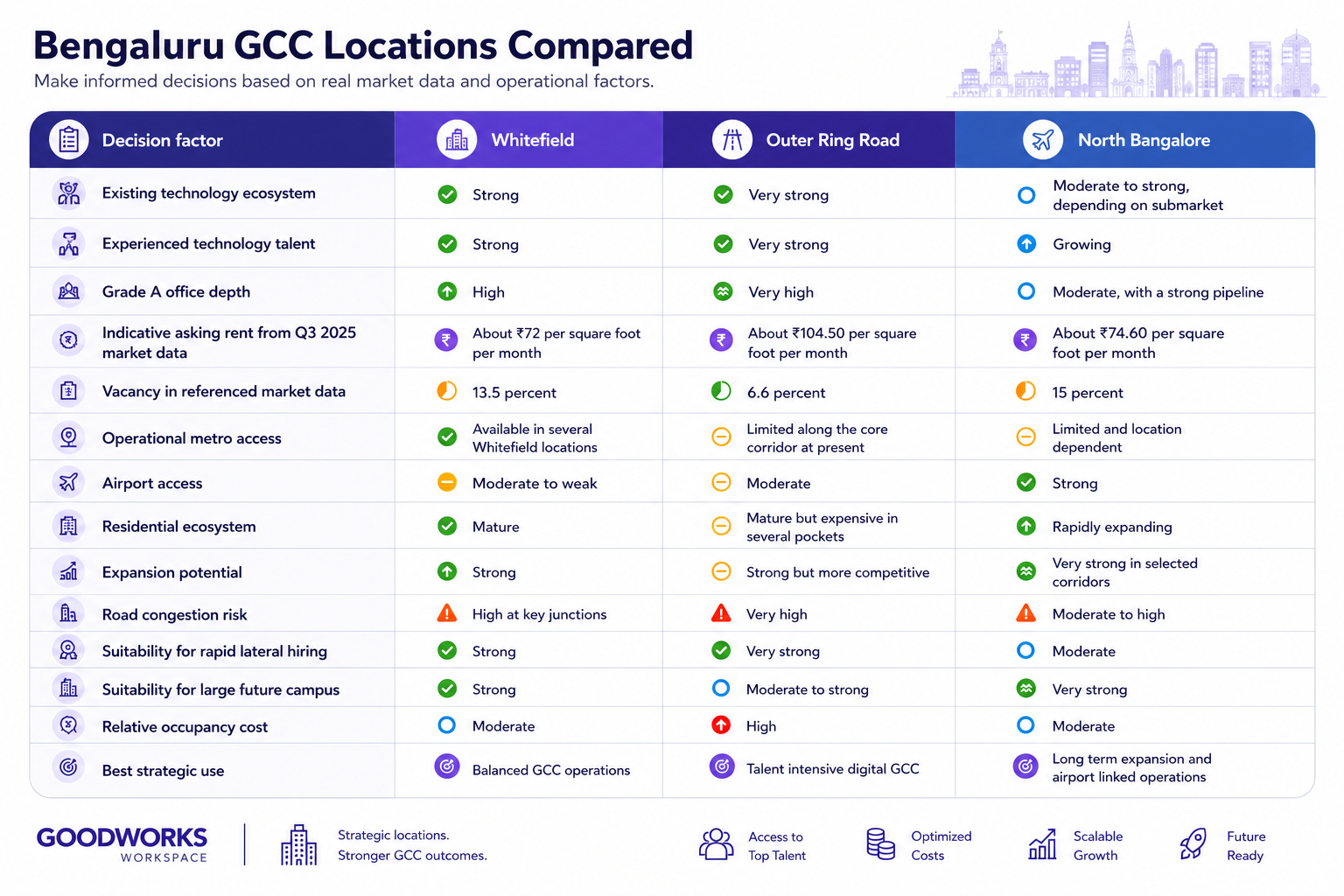
Source note: Rent, vacancy, stock and pipeline comparisons use Cushman and Wakefield’s third quarter 2025 Bengaluru office classifications. Actual building quotations and commercial terms will differ.
The CEO should ask which location strengthens the GCC’s mandate.
A GCC focused on product ownership, global engineering and senior decision making needs access to experienced leaders and specialist talent. Outer Ring Road often provides the strongest immediate ecosystem.
A GCC focused on balanced growth, cost control and multi function operations may find Whitefield more suitable.
A GCC designed as a long term regional hub, engineering campus or airport connected centre may gain more from North Bangalore.
The CEO should avoid selecting a location purely for brand visibility. The office must support the company’s operating model for at least five years.
Key questions include:
The CFO should compare total occupancy cost rather than rent alone.
A reliable model should include:
Property cost: Rent, escalation, maintenance, parking, deposits and taxes.
Capital cost: Design, furniture, technology, security, meeting rooms and reinstatement.
People cost: Transport, commute related attrition, joining incentives and productivity loss.
Flexibility cost: Unused capacity, expansion constraints, early exit charges and lease lock in.
Risk cost: Utility disruption, building failure, access disruption and business continuity arrangements.
For example, Outer Ring Road’s quoted average rent in the referenced report was about ₹32.50 per square foot per month above Whitefield’s market average. Across 100,000 square feet, that difference represents approximately ₹3.25 million per month before maintenance, taxes and escalation.
That calculation does not prove that Whitefield is cheaper overall. It shows the size of the property premium that Outer Ring Road must justify through talent, productivity, leadership access or strategic value.
A managed office model can reduce early capital exposure and allow the company to align capacity with hiring. It can be especially useful during the first stage of a GCC, when workforce forecasts may change.
The CTO should evaluate location through the talent architecture.
Different technology roles have different location sensitivity.
Senior product engineers, cloud architects, cybersecurity specialists and data leaders may already work along Outer Ring Road or in East Bengaluru. Their willingness to commute to another corridor can affect hiring time and compensation.
The CTO should map:
Whitefield and Outer Ring Road generally provide the strongest immediate access to established technology talent.
North Bangalore can support strong technology teams, but the employer may need a more deliberate hiring, transport and hybrid work strategy.
Use anonymised employee and candidate location data. Plot current and expected home locations across Bengaluru.
Do not use straight line distance. Estimate peak travel time for each office under consideration.
Measure:
Treat an operational metro line as a current benefit.
Treat an approved or under construction line as an upside case, not the base case.
Lease commitments often begin before major infrastructure becomes fully operational. Delays can affect the employee experience for several years.
A location that works for finance operations may not work for semiconductor engineering.
Interview recruiters, search firms and business leaders. Review candidate drop off by postcode or residential cluster.
Assess:
A GCC can outgrow its first office faster than expected.
Negotiate expansion options, rights over adjacent floors, phased delivery and the ability to add secure areas without moving the entire operation.
Create at least three growth cases:
Test each location against headcount, space, transport and total cost.
Choose Whitefield when the company wants a mature technology environment, metro access, a large residential base and more moderate real estate cost than Outer Ring Road.
It is often the most balanced choice for a new GCC that needs credibility, talent and financial control.
Choose Outer Ring Road when access to experienced technology talent is the most important factor and the business can justify higher occupancy cost.
It is especially suitable for product engineering, digital, data, financial technology and cybersecurity mandates.
Choose North Bangalore when airport access, future expansion and a large campus matter more than immediate proximity to the city’s deepest technology talent pool.
It is particularly relevant to aerospace, engineering, manufacturing technology and regional leadership operations.
A large GCC does not always need to select one corridor for every function.
A company may place product engineering and leadership on Outer Ring Road while locating scalable operations in Whitefield or North Bangalore.
A two location model can improve talent access and business continuity. It can also create management complexity. The model works only when functions, transport, security and collaboration practices are clearly designed.
A conventional lease often requires a large deposit, long commitment, fit out capital and a detailed capacity forecast.
A managed office can allow a GCC to:
For foreign companies entering Bengaluru, this can separate the legal entity and talent launch from the longer real estate decision.
GoodWorks Spaces provides customised managed offices in Grade A buildings across key Bengaluru business districts. Its workspace model is designed for enterprises that require private offices, scalable capacity, secure infrastructure and more generous space per employee.
A GCC should still conduct technical and commercial due diligence. A managed solution changes the delivery model, but it does not remove the need to evaluate transport, utilities, compliance and business continuity.
There is no universal winner in the Whitefield vs Outer Ring Road vs North Bangalore comparison.
Outer Ring Road wins on immediate enterprise ecosystem and experienced technology talent.
Whitefield wins on balance, particularly when cost, metro access, office choice and East Bengaluru’s workforce are considered together.
North Bangalore wins on airport access, future supply and long term expansion potential.
For many mid size foreign enterprises launching their first Bengaluru GCC, Whitefield provides the most balanced starting position.
For large technology companies building high value engineering and product functions, Outer Ring Road can justify its premium.
For companies planning a campus, regional headquarters or aerospace and engineering capability centre, North Bangalore deserves serious evaluation.
The final decision should be based on building level evidence, not the reputation of a broad corridor.