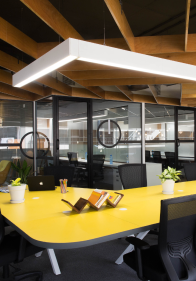
Setting up a Global Capability Center (GCC) in India has evolved from a back-office decision into a strategic business move. As of March 2026, India was home to 2,117 GCCs, with more than 100 new centers added during FY2026, according to the Nasscom–Zinnov India GCC Landscape Report 2026. What many companies underestimate is the role workspace plays in this trajectory: the location, format, and infrastructure chosen at setup can shape a GCC’s ability to scale efficiently over time. Workspace decisions intersect with several strategic priorities: access to talent pools, operational flexibility, technology readiness, security, and business continuity making them a meaningful factor in how smoothly a center grows from its first cohort of employees to a larger, more mature operation.
This is where GCC workspace solutions become a growth lever rather than just a real estate line item. In this blog, we look at how workspace strategy can support a GCC through every phase from initial GCC setup in India to full-scale, multi-city operations.
Most conversations about GCCs focus on talent, compliance, and cost arbitrage and rightly so. But workspace is the physical layer that can support or constrain all three. A center that outgrows its office within 12 months may face relocation disruption, added fit-out costs, and employee-experience challenges at exactly the moment it needs stability to attract senior talent.
Real estate data underscores the scale of this consideration: ICRA projects that GCCs will incrementally lease 50–55 million sq. ft. of Grade-A office space across India’s top six markets during FY2026 and FY2027, accounting for an estimated 38–40% of overall office demand. This makes workspace a consequential and often underappreciated decision in a GCC’s lifecycle.
Companies that scale smoothly often treat workspace as a growth-infrastructure decision rather than a one-time transaction. That means planning for three distinct phases.
The first 90 days of a GCC setup in India can set the tone for what follows. At this stage, speed and low commitment often matter more than square footage.
What a growth-ready setup phase can look like:
At this stage, the workspace decision should help answer one question: can the team start delivering value without locking into square footage that isn’t yet needed?
Once a GCC moves beyond its initial pilot team and into a larger, more permanent operating footprint, priorities shift toward operational consistency, employer branding, and scalable workplace systems.
Key workspace considerations in this phase:
This is also often the point at which GCCs encounter the limits of a purely transactional real estate relationship. A workspace partner who understands the GCC operating model — not just square-footage leasing can become important here, as compliance, workforce, and facility needs start to intersect.
As GCCs mature, some expand beyond a single facility or city to access talent, support resilience, or serve different business functions. The FY2026 Nasscom–Zinnov GCC Landscape Report records 3,728 operating units across 2,117 GCCs about 1.8 units per GCC indicating that many GCCs operate beyond a single facility.
What scaling well can require from a workspace standpoint:
At scale, workspace tends to move beyond being just “an office” and becomes part of the GCC’s broader operating infrastructure, alongside its technology stack and talent pipeline.
When evaluating GCC office space providers, it helps to look beyond desk pricing. A well-suited partner may offer:
This is one reason many global companies choose to work with a single accountable platform that combines workspace with broader GCC setup and operations support, rather than coordinating separately with a real estate broker, a facility manager, and a compliance consultant.
Even well-funded GCCs can run into workspace-related setbacks. Common workspace risks include:
Reducing these risks is less about picking a fancier office and more about choosing a workspace partner who understands the broader GCC lifecycle not just the lease.
Many successful GCCs in India treat workspace as a strategic consideration from day one, rather than a decision revisited only once the current office runs out of space. Whether a company is setting up its first pilot team or scaling to a multi-city operation, the right GCC workspace solutions can support the flexibility and consistency that help an India center grow in line with business needs.
Ready to think through a workspace strategy for your GCC?