Smart Offices in India use connected sensors, workplace software, building systems and AI to understand how space is being used and respond to changing demand. The goal is not to add more gadgets. It is to create a measurable, secure and responsive workplace that improves employee experience while controlling real-estate and operating costs.
For enterprises and Global Capability Centres, this means moving from assumptions to evidence. An effective AI workplace can identify underused desks, predict meeting-room demand, adjust services according to footfall and help facilities teams address problems before they affect employees.
A smart office is a workplace in which physical infrastructure and digital platforms share data to improve decisions and automate selected actions. It connects systems such as access control, lighting, HVAC, room booking, environmental sensors, visitor management, service requests and an integrated workplace management system.
A conventional office records events in separate systems. A smart office connects those events.
For example, a traditional meeting-room system may show that a room was booked for two hours. A smart system can determine whether anyone entered, how many people attended, whether the indoor environment remained comfortable and whether the room became available earlier than expected.
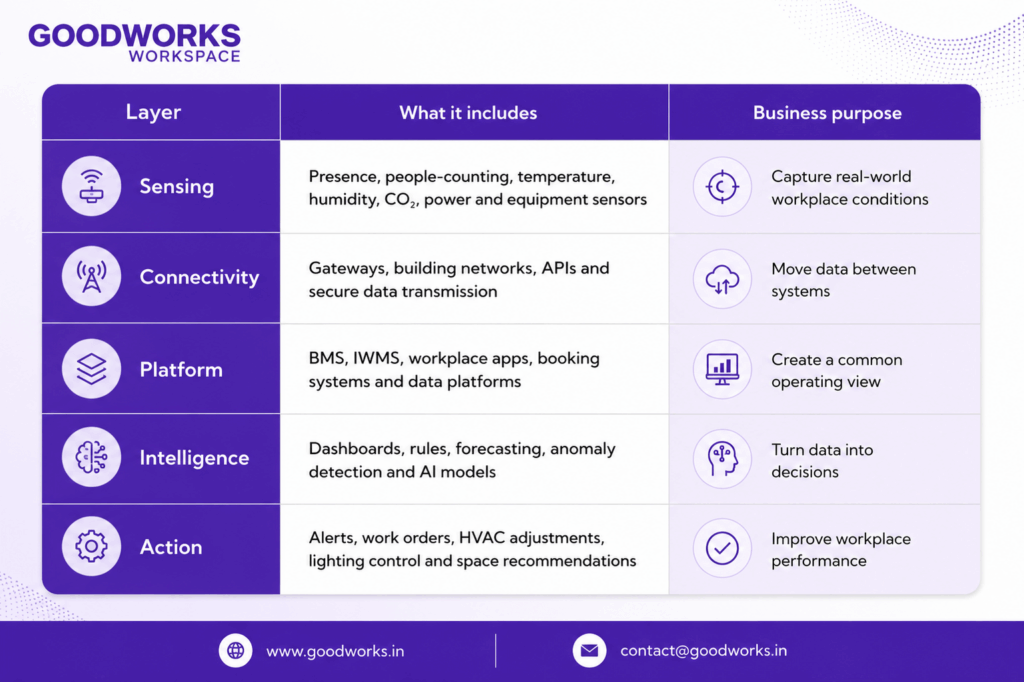
A PropTech office generally operates through five connected layers:
Companies should define the numerator, denominator, measurement interval and exclusions before comparing utilisation across locations. Otherwise, two teams can produce different results from the same building.
An AI workplace can apply forecasting or anomaly-detection models to historical and real-time data.
Potential use cases include:
AI does not correct poor underlying data. CBRE found that data-quality problems and limited expertise were the most frequently cited AI-integration challenges, reported by 55% of respondents in its 2026 workplace research.
JLL found a similar execution gap. Although 78% of surveyed business and corporate-real-estate leaders expected AI to affect portfolio strategies over the following three to five years, only 15% had moved beyond exploration and early deployment to active optimisation. The survey covered more than 2,200 leaders across 21 countries.
The right sensor depends on the required accuracy, installation conditions, privacy risk, latency and cost. Companies should avoid choosing technology solely on purchase price or vendor claims.
Common options include:
Passive infrared sensors: Useful for detecting movement and controlling lighting. They can miss occupants who remain still for long periods.
Desk-presence sensors: Useful for workstation-level utilisation. Organisations should aggregate their output rather than create employee-level movement histories unless there is a clear and lawful need.
Thermal or radar-based counters: Useful for counting people without capturing conventional video. Accuracy depends on placement, room layout and calibration.
Wi-Fi analytics: Can estimate device presence by zone. One person may carry several devices, while some devices may not connect, so raw device counts do not equal people counts.
Access-control data: Provides reliable entry events but usually does not show where people spend time after entering a building.
Environmental sensors: CO₂, temperature and humidity data can support comfort and ventilation decisions. CO₂ can provide an occupancy proxy, but it should not be treated as an exact people count.
Computer-vision systems: Can support detailed counting and behavioural analysis, but they create greater privacy, cybersecurity and workforce-trust considerations.
India’s Bureau of Energy Efficiency has already incorporated occupancy-responsive controls into the Energy Conservation and Sustainable Building Code 2024. The code specifies automatic control for at least 90% of interior lighting by wattage and provides for occupancy sensors that turn off or substantially dim lighting within 15 minutes of a space becoming unoccupied. It also specifies occupancy sensors for conference and meeting rooms. Project teams must still check state and local applicability.
Occupancy analytics improves experience when it removes friction rather than monitoring employees. The most valuable applications help people find appropriate space, maintain comfortable conditions and access workplace services with less effort.
Examples include:
Smart-office design should combine quantitative data with employee interviews, service feedback and observation. A dashboard may show that a lounge is underused, but employee research may reveal that noise, glare, furniture layout or poor connectivity causes the problem.
Data tells the team where to investigate. It does not always explain why a behaviour occurs.
For GCCs, the strongest business case combines portfolio scalability, operational resilience, employee experience and governance. A GCC may grow quickly, support multiple time zones and operate under global technology, security and sustainability standards.
Occupancy analytics can help a GCC:
The financial model should remain transparent:
Annual net benefit = avoided or deferred space cost + operating savings + service-efficiency gains − recurring technology cost
Indicative payback period = implementation cost ÷ annual net benefit
Companies should not insert generic industry percentages into this calculation. They should establish an eight-to-twelve-week baseline and use their own rents, service contracts, attendance patterns and equipment data.
Smart-office data can create legal, ethical and employee-relations risks when organisations collect more information than the use case requires or connect aggregated occupancy data to identifiable individuals. Privacy and cybersecurity must form part of the design brief, not a final compliance review.
India’s Digital Personal Data Protection Act defines personal data as data about an individual who is identifiable by or in relation to that data. Badge events, named bookings, device identifiers and certain video outputs can therefore fall within the framework when they identify or can be linked to an employee or visitor.
Prefer anonymous counts, zone-level aggregation and short retention periods whenever individual identity is unnecessary.
The Central Government notified the final DPDP Rules in November 2025 with a phased commencement schedule. Some provisions took effect immediately, another phase is scheduled after one year, and many core processing and security provisions are scheduled eighteen months after notification. As of July 2026, organisations should prepare for the target operating model while confirming the provisions in force on the deployment date with legal counsel.
The final rules’ target safeguards include measures such as encryption or masking, access controls, logs, monitoring, backups and appropriate security clauses in processor contracts.
Every smart-office programme should define:
Facilities, IT, information security, HR, legal and employee-experience teams should approve the operating model together.
Companies should begin with one measurable problem, establish a baseline, run a controlled pilot and scale only after verifying data quality and user acceptance. A technology-first rollout usually creates dashboards without sustained operational value.
Start with a specific question, such as:
Review booking platforms, access control, BMS, ticketing systems, workplace apps, Wi-Fi infrastructure, energy meters and existing sensors.
Many organisations already hold useful data but cannot combine it because formats, timestamps or location names do not match.
Measure attendance, occupancy, room bookings, no-shows, complaints, energy consumption and relevant service costs before changing the workplace.
Include ordinary weeks and peak periods. Exclude holidays, special events and abnormal operating conditions where appropriate.
Choose one floor or business unit that reflects typical workplace behaviour. A pilot should test:
Assign an owner to each alert or recommendation. A no-show metric creates value only when the booking system releases unused rooms. An energy anomaly matters only when an engineer investigates it.
Compare the pilot with its baseline. Scale only the use cases that demonstrate reliable data, operational adoption and a credible economic or experience benefit.
A smart-office RFP should evaluate outcomes, architecture, governance and long-term interoperability not only sensors and licence fees.
Ask prospective providers to address:
Avoid an architecture that locks every building system into one proprietary platform. Open APIs and exportable data make future upgrades easier.
A managed-office model can reduce implementation time by bringing design, facilities, technology, security and workplace operations under one accountable partner. This can be particularly valuable for new GCCs, project teams and enterprises that do not want to assemble multiple building and service vendors.
However, occupiers should still define their data rights, security requirements, integrations, reporting needs and service-level expectations before signing an agreement.
GoodWorks offers managed office spaces and custom enterprise workspaces for organisations that need scalable, professionally operated offices. Companies planning a new capability centre can also review the GoodWorks GCC workspace and operations guide.
Before selecting a provider, ask for a use-case workshop rather than a generic technology demonstration. Begin with the workplace decision you want to improve, then determine the minimum technology required to support it.