Enterprises expanding across multiple locations face a structural challenge: how to build a hybrid workplace strategy that maintains culture, governance, cost efficiency, and operational control across 10+ cities.
Hybrid work is no longer optional. However, scaling it without clear workplace infrastructure often leads to inconsistent employee experience, fragmented culture, and rising real estate costs.
This guide outlines a practical, insight-led approach to building a multi-city hybrid workplace strategy, integrating managed office space and coworking space solutions for enterprise resilience.
For enterprises operating in cities like Bangalore, Mumbai, Hyderabad, Pune, Delhi NCR, and Chennai, workforce distribution is no longer centralized.
A successful enterprise hybrid workplace strategy must address:
Organizations that fail to build structured hybrid workplace systems risk inefficiency and attrition.
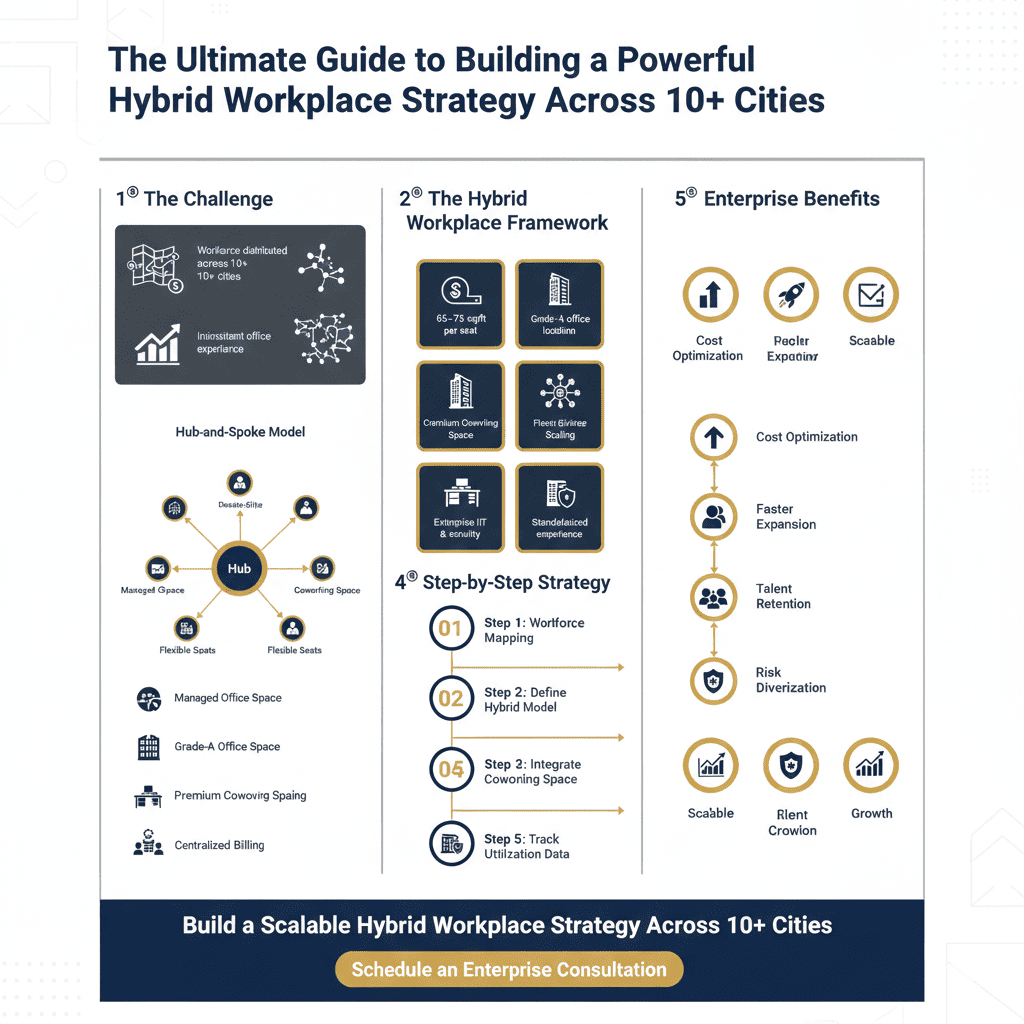
The traditional HQ model is being replaced by a hub and spoke workplace strategy.
This hybrid work model enables enterprises to remain agile while maintaining brand presence across geographies.
Coworking space is no longer just for startups. Enterprises are increasingly integrating premium coworking space into their hybrid workplace framework.
Why?
For enterprises managing workforce spread across 10+ cities, coworking space provides operational agility without infrastructure complexity.
Long-term commercial leases limit agility. A managed office space model enables:
This supports controlled hybrid implementation.
In a distributed workforce model, inconsistency damages culture.
A successful multi-city office strategy requires:
This is where structured coworking space providers and managed office operators play a strategic role.
Traditional coworking models operate at high density. However, enterprise hybrid models require lower density for collaboration and flexibility.
GoodWorks Spaces offers 65–75 sqft per seat significantly higher than industry averages.
This supports:
For enterprises implementing hybrid workplace strategy, spacious layouts directly influence engagement and productivity metrics.
Identify:
Use this data to determine office density and coworking space integration.
Select from:
Align your real estate strategy with workforce patterns.
Instead of overcommitting to leased offices, use coworking space for:
This reduces CAPEX while preserving scalability.
Across 10+ cities, enterprises must control:
Managed office space partners simplify this with unified agreements and centralized reporting.
Track:
Data enables continuous refinement of hybrid workplace strategy.
Hybrid employees come to office for collaboration, not routine desk work.
Therefore, the office must deliver:
Premium coworking space bridges the gap between flexibility and enterprise standards.
1. Cost Optimization : Flexible office space reduces long-term liabilities.
2. Talent Expansion : Multi-city presence widens hiring pools.
3. Risk Diversification : Distributed teams reduce operational disruption.
4. Scalability : Seat allocation adjusts to demand.
5. Faster Geographic Expansion : Launch operations without infrastructure build-outs.
GoodWorks operates premium coworking space and managed office space solutions in Grade-A buildings.
Key enterprise advantages:
For enterprises scaling across Bangalore and beyond, GoodWorks supports structured hybrid workplace strategy without operational fragmentation.
Over the next five years, enterprise workplace models will prioritize:
Organizations that adopt scalable managed office space frameworks today will gain long-term cost and agility advantages.
Building a hybrid workplace strategy across 10+ cities is not about adopting flexible work. It is about structuring real estate, governance, and employee experience into a cohesive system.
Coworking space and managed office space are no longer optional add-ons. They are core infrastructure for enterprise agility.
Enterprises that integrate premium coworking space into a structured multi-city office strategy will operate faster, leaner, and more resiliently.
Build Your Multi-City Hybrid Workplace Strategy Today