India is no longer just a cost-arbitrage destination for global enterprises. It has become the world’s GCC capital.
As of 2026, India hosts over 1,700 Global Capability Centers employing nearly 1.9 million professionals — a number that continues to climb as Fortune 500 companies, mid-market enterprises, and high-growth startups all seek a deeper footprint in one of the world’s largest talent markets. Bangalore alone accounts for more than 35% of all GCC operations in the country, driven by its concentration of engineering talent, established IT infrastructure, and mature ecosystem of support services.
If your organisation is evaluating a GCC setup in India, this guide covers everything you need to make it happen from choosing your legal entity and selecting the right city, to finding and moving into GCC-ready office space. Most setup guides stop at strategy. This one goes all the way to the point where your team is actually at their desks.
Already decided? Talk to GoodWorks about GCC office space in Bangalore →
A Global Capability Center also referred to as a Global In-house Center (GIC), Center of Excellence (CoE), or Captive Center is a dedicated offshore operational unit established by a multinational corporation in a different country to deliver services to the parent organisation.
Unlike outsourcing, a GCC is fully owned and controlled by the parent company. The teams working within it are employees of the company, operating under its culture, processes, and governance. The functions a GCC delivers have evolved significantly over the past two decades:
Today’s GCC in India is not a back-office unit. It is, for many global companies, the core of their technology and innovation engine.
Before walking through the setup process, it is worth understanding why India dominates the global GCC landscape and why Bangalore, in particular, has become the default first choice for most companies.
Setting up a GCC is not a single decision it is a phased operational programme. Here is the roadmap that most successful GCC launches follow.
Before any paperwork is filed or office is shortlisted, you need absolute clarity on what your GCC is meant to deliver.
There are three broad GCC models:
Define early: your target headcount at launch and at 3-year maturity, the functions you intend to deliver, the reporting structure to HQ, and your go-live timeline. These decisions will drive every downstream choice city, entity, office size, and hiring strategy.
India has several mature GCC cities, and the right choice depends on your functional focus:
Bangalore is India’s dominant GCC hub and the default choice for technology, product, and R&D-focused GCCs. The city accounts for more than a third of India’s GCC base. Within Bangalore, the leading GCC micro-markets are:
For most tech and product GCCs, Bangalore remains the first recommendation and within Bangalore, Whitefield and the ORR corridor deliver the best combination of talent density, infrastructure quality, and ecosystem support.
Setting up a GCC in India requires establishing a legal entity under Indian law. The four main options are:
Wholly Owned Subsidiary (WOS): Registered as a Private Limited Company under the Companies Act, 2013. This is the most common and recommended structure for GCCs. It gives the parent company 100% ownership and full operational control.
Branch Office: An extension of the parent company rather than a separate legal entity. Suitable for companies providing services or conducting research, but carries more regulatory complexity around repatriation of funds and scope of permitted activities. Requires RBI approval.
Liaison Office: The most restricted option; can only conduct market research and promotion, not revenue-generating activities. Not suitable for most GCC mandates.
Limited Liability Partnership (LLP): Used in specific cases where an Indian partner is involved. Uncommon for standard GCC structures.
For the vast majority of international companies setting up a GCC in India, the WOS (Private Limited Company) is the right choice. Typical incorporation timeline: 4 to 8 weeks from filing to Certificate of Incorporation.
Tax note: All transactions between the GCC and the parent company must be conducted at arm’s length under India’s Transfer Pricing regulations. Ensure you have a qualified CA or tax advisor to establish the right cost-plus or intercompany pricing model from the start.
This is the step where most GCC planning processes slow down and the step where GoodWorks delivers the most direct value.
There are two fundamentally different approaches to GCC office space in India:
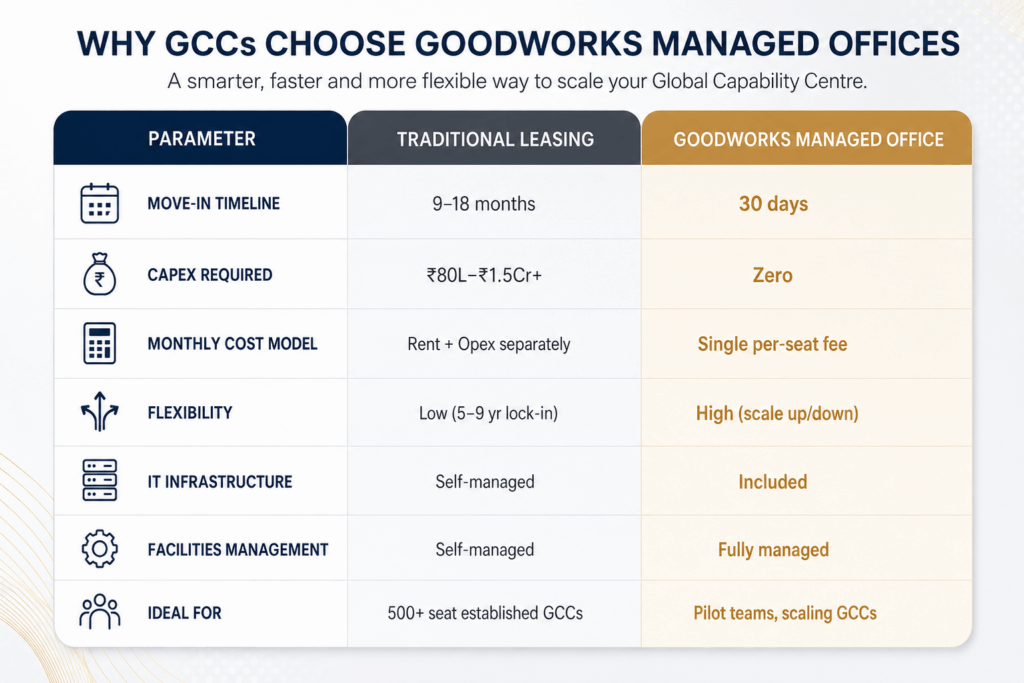
Traditional Commercial Leasing You identify a Grade-A building, negotiate a direct lease (typically 5 to 9 years), and commission a fit-out design, construction, furniture, IT cabling, and facilities setup. This approach gives maximum customisation and long-term cost optimisation at scale, but the time and capital requirements are significant:
You lease seats or dedicated floors within an already-fitted, professionally managed commercial space. Everything furniture, IT infrastructure, high-speed fibre, security, cafeteria, housekeeping is included in a single monthly per-seat fee. The unit economics look different:
For GCC teams entering India for the first time, or scaling from a pilot to full operations, the managed office model is almost universally the faster, lower-risk choice. It eliminates the capital, operational distraction, and timeline uncertainty of a traditional fit-out allowing your leadership to focus on talent hiring and capability building from day one.
GoodWorks’ managed offices across Bangalore are purpose-built for enterprise GCC teams Grade-A OC-compliant buildings, award-winning interior design, enterprise-grade fibre, 24/7 security, on-site cafeteria, and the GoodWorks HQ App for centralised workspace management.
Explore GCC-ready office space in Bangalore →
Office secured and entity incorporated now comes the hardest part: building the team.
India’s GCC talent market is competitive. You are hiring from the same pool as Google, Microsoft, Amazon, and hundreds of other established GCCs. A few strategies that work well for GCC launches:
Anchor hire first. Bring in 2 to 3 senior leaders (Director/VP level) with prior GCC or India delivery experience before you hire anyone else. These leaders will shape the culture, own the hiring plan, and give your GCC credibility in the local talent market.
Leverage Bangalore’s GCC talent density. Whitefield and the ORR corridor have the highest concentration of mid-to-senior tech professionals in India who have already worked in GCC environments. Being physically located in these corridors in a well-recognised building like SJR iPark or Prestige Shantiniketan significantly improves employer brand perception.
Use an Employer of Record (EOR) for speed. If your legal entity is still being incorporated, an EOR partner can hire employees on your behalf from day one, with a smooth transfer to your entity once it is ready. This can save 6 to 8 weeks off your team build timeline.
Invest in employer branding early. Top talent in Bangalore does due diligence. Your LinkedIn presence, Glassdoor profile, office photos, and community within the workspace all matter. GoodWorks’ coworking community, events programme, and well-known brand presence in Whitefield have directly benefited member companies’ talent attraction.
Once your GCC is live, the compliance calendar begins. Key ongoing requirements:
Most GCCs engage a local CA firm and HR compliance partner from the outset. GoodWorks works with a curated ecosystem of legal, compliance, and HR partners to help member companies navigate this from Day 1.
One of the most frequent questions from CFOs evaluating India GCC setups is: what does this actually cost?
Here is a realistic cost breakdown for a 100-person GCC in Bangalore:
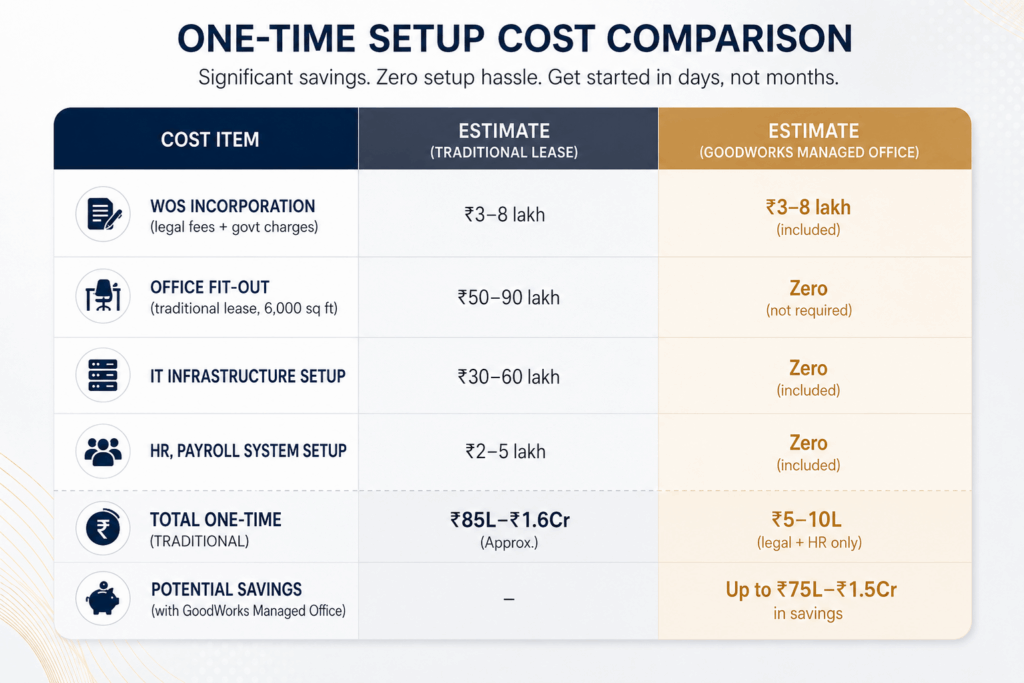
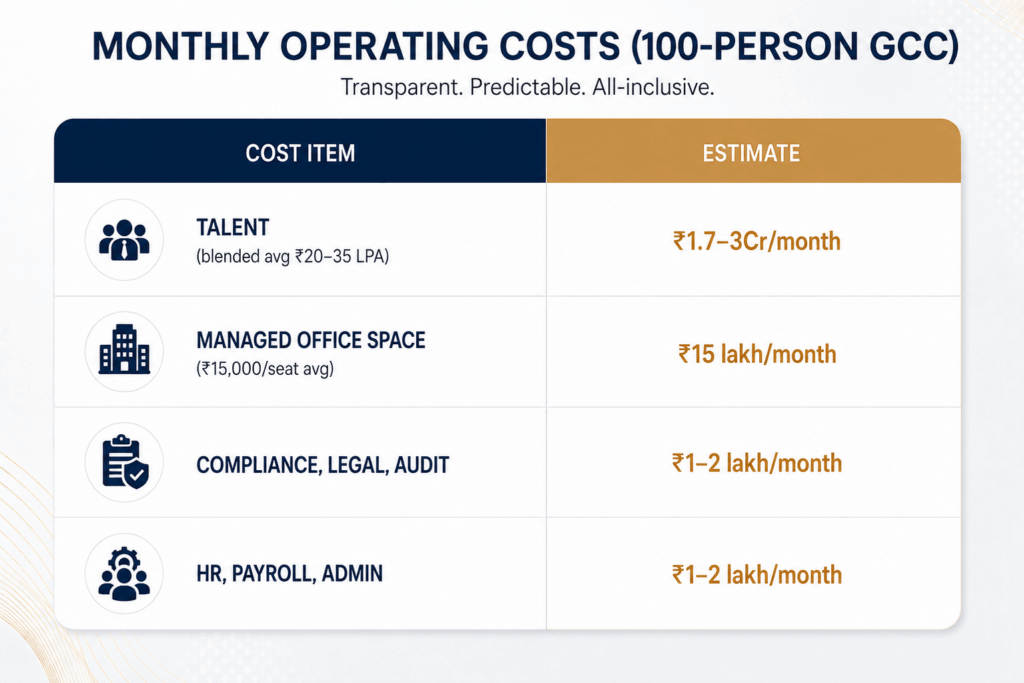
The most significant cost driver is always talent and India’s cost advantage over equivalent US/UK operations remains substantial. For a 100-person software engineering team, the total cost of operations in Bangalore is typically 35 to 50% lower than an equivalent team in the US, even after accounting for all India-side infrastructure costs.
GoodWorks is Bangalore’s No.1 coworking and managed office provider, with 10,000+ seats across the city’s prime GCC corridors. Here’s what makes GoodWorks the preferred workspace partner for enterprise GCC setups:
Speed to market. GoodWorks’ managed offices are move-in ready. Your GCC team can be operational within 30 days of signing no construction, no procurement, no facilities management overhead.
Grade-A locations, exclusively. Every GoodWorks centre operates out of OC-compliant, Grade-A commercial properties. Locations include SJR iPark (Whitefield), EPIP Zone Akshay Tech Park (Whitefield), Prestige Shantiniketan (Whitefield), Infinity Park (Electronic City), and ORR Bellandur all in Bangalore’s top GCC corridors.
Scale from Day 1. Start your GCC pilot with 50 seats and scale to 1,000+ within the same ecosystem, with no relocation disruption.
Custom branded GCC spaces. For teams requiring a fully dedicated, branded environment, GoodWorks’ award-winning architects will design your space your branding, your culture, your layout and deliver it in 30 days.
Enterprise clients trust GoodWorks. TESCO, Intertrust Technologies, and 100+ enterprise clients operate from GoodWorks-managed spaces across Bangalore.
GoodWorks Advantage. Member companies receive discounts from a curated partner ecosystem covering cloud infrastructure, legal, HR, payroll, and logistics reducing the vendor management overhead of a new India setup.
View GCC-ready managed office locations in Bangalore →